
Ras Ajdir works, western Libya. Photo: Najme Almansory
Solar sea salt from Ras Ajdir, shipped in bulk.
Al Mozan produces washed sea salt in evaporation basins on Libya’s western coast and exports it in bulk from Tripoli and Zuwara to manufacturers, refiners and distributors in fifteen industries, from chemicals, textiles and water treatment to food-salt refining, agriculture and winter roads.
Salt for every industry
One washed solar salt, quoted against each sector's specification. Choose your industry for what its buyers specify, what we supply today and a request form.
Food, agriculture and health
Chemicals and manufacturing
Water and energy
Roads and distribution
What we supply
Three grades of washed and raw solar salt, quoted against your specification and confirmed by independent inspection at the load port. Food, feed, cosmetic and pharmaceutical routes are set out on each industry page.

Industrial salt
Washed and raw solar salt for chemicals, textiles, leather, detergents, metal processing and salt refiners, at 98.7–99.4 % NaCl.
From one container bagged or 3,000 t in bulk
Water-treatment salt
Coarse washed salt for softeners, brine systems, electrochlorination and pools, tested per lot.
From 200 t in bags and big bags
De-icing salt
Coarse washed sea salt for road-salt importers and winter services. 79 % between 2 and 8 mm.
From 3,000 t in bulk or 100 t in big bagsFood, feed, cosmetic and pharmaceutical uses are set out industry by industry: what each sector requires and where documentation stands. All industries
Not offered: pharmaceutical grade, chlor-alkali membrane feed, softener tablets, iodised table salt, or anything described as organic.
How the salt is made
Sun and wind do the work in four stages. The colour of each pond shows how far the brine has concentrated, measured in degrees Baumé (°Bé).
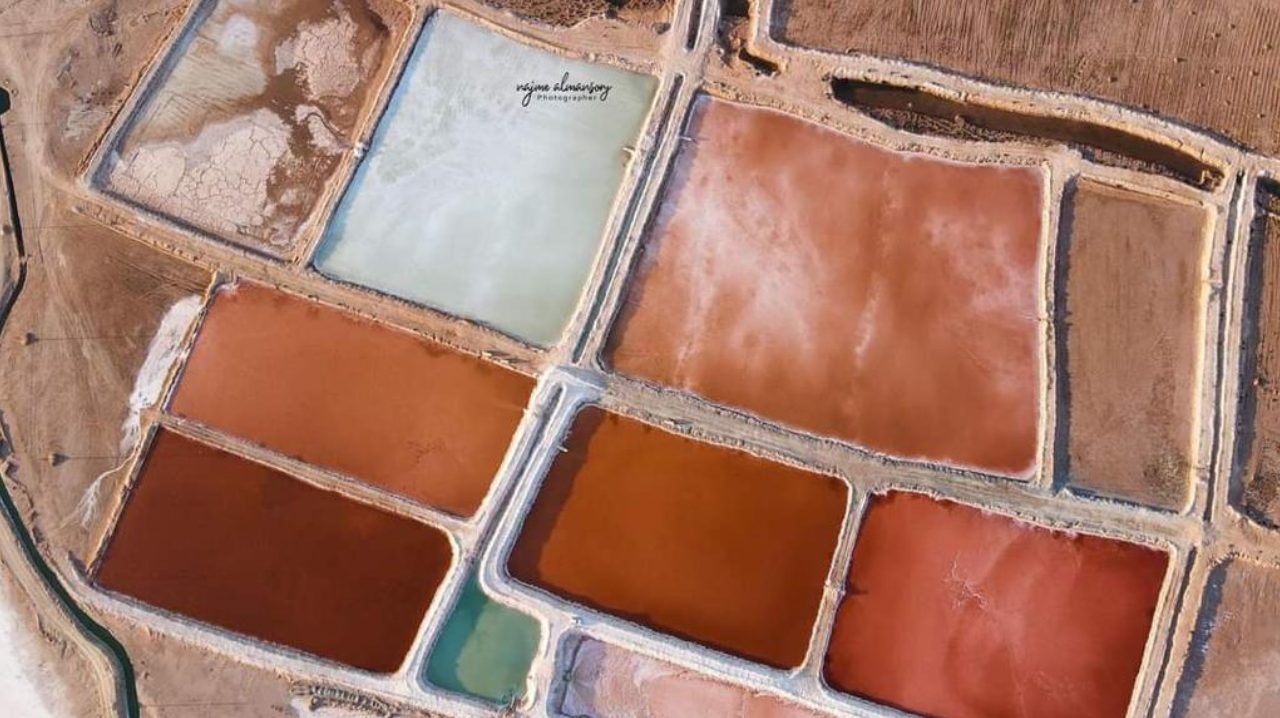
Concentration
3.5 to 13 °Bé
Seawater and sabkha brine flow through shallow concentrator ponds. Sun and wind raise the density step by step, and calcium carbonate settles first.
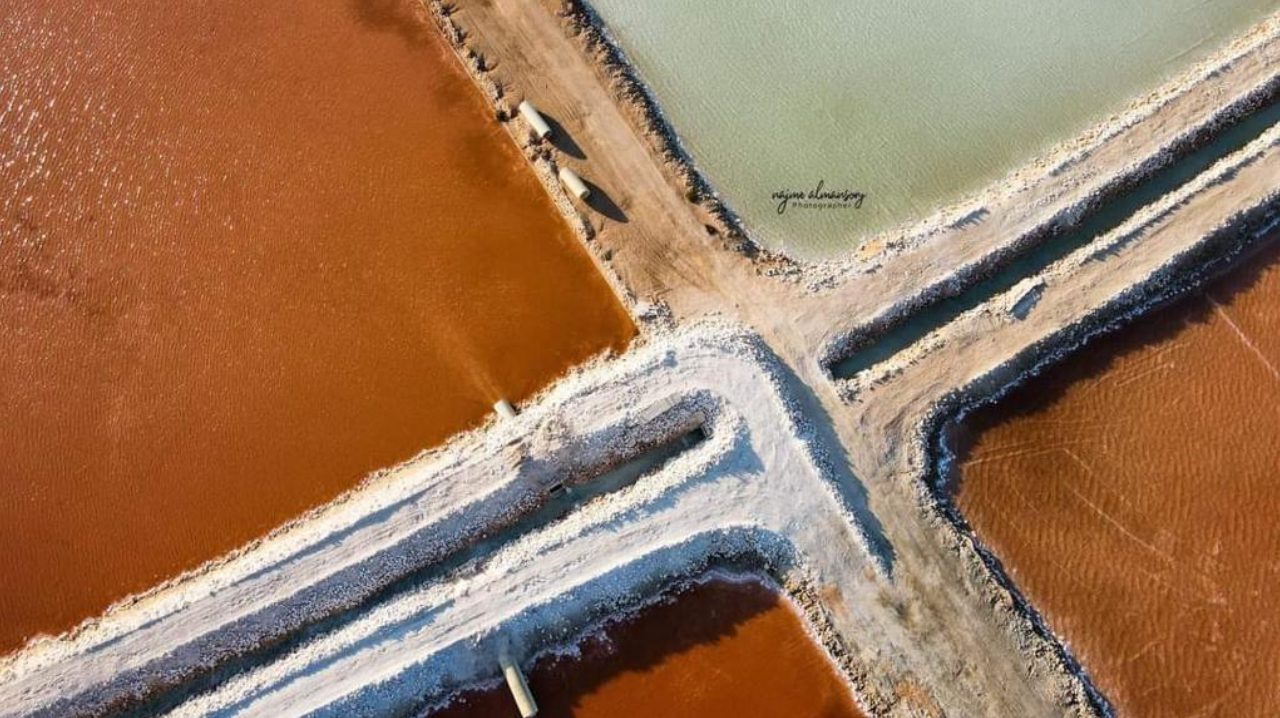
Brine transfer
13 to 25 °Bé
Brine passes between ponds through pipes in the levees. Gypsum settles in these middle ponds, which keeps calcium sulphate out of the salt.
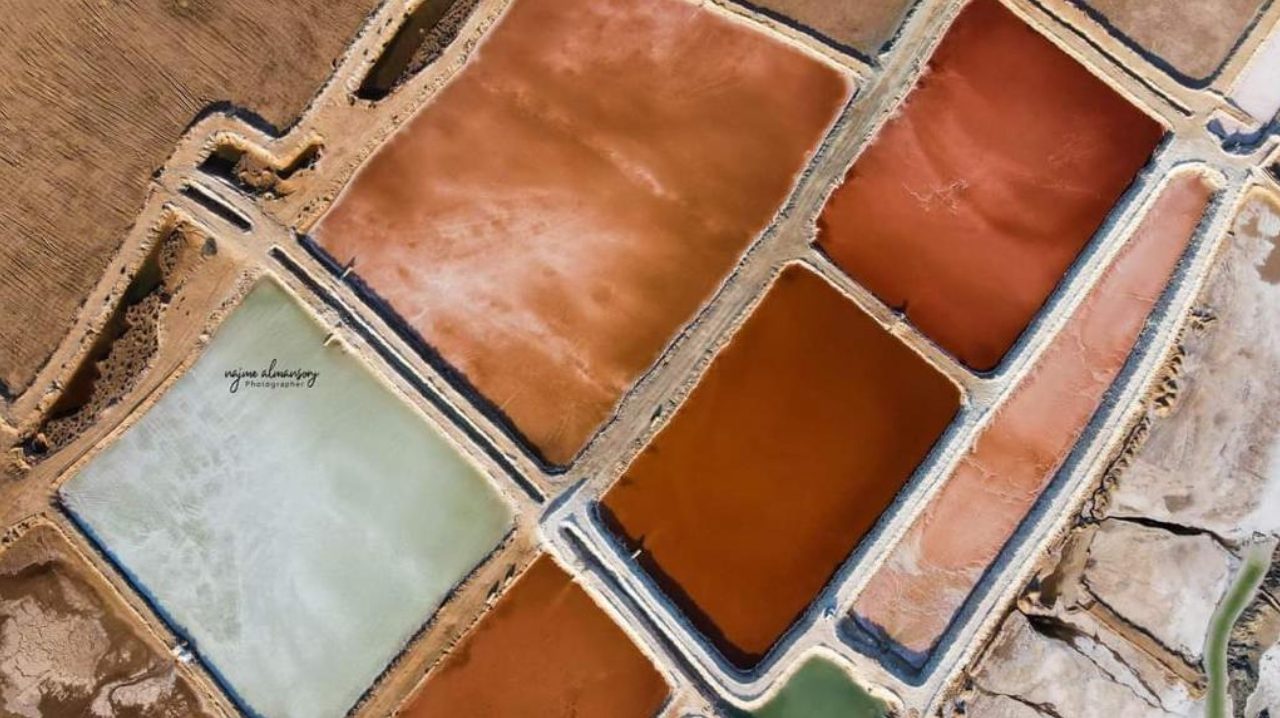
Crystallisation
25.7 to 29 °Bé
At saturation the brine turns red with salt-tolerant microalgae, and sodium chloride crystallises on the pond floor through the summer.
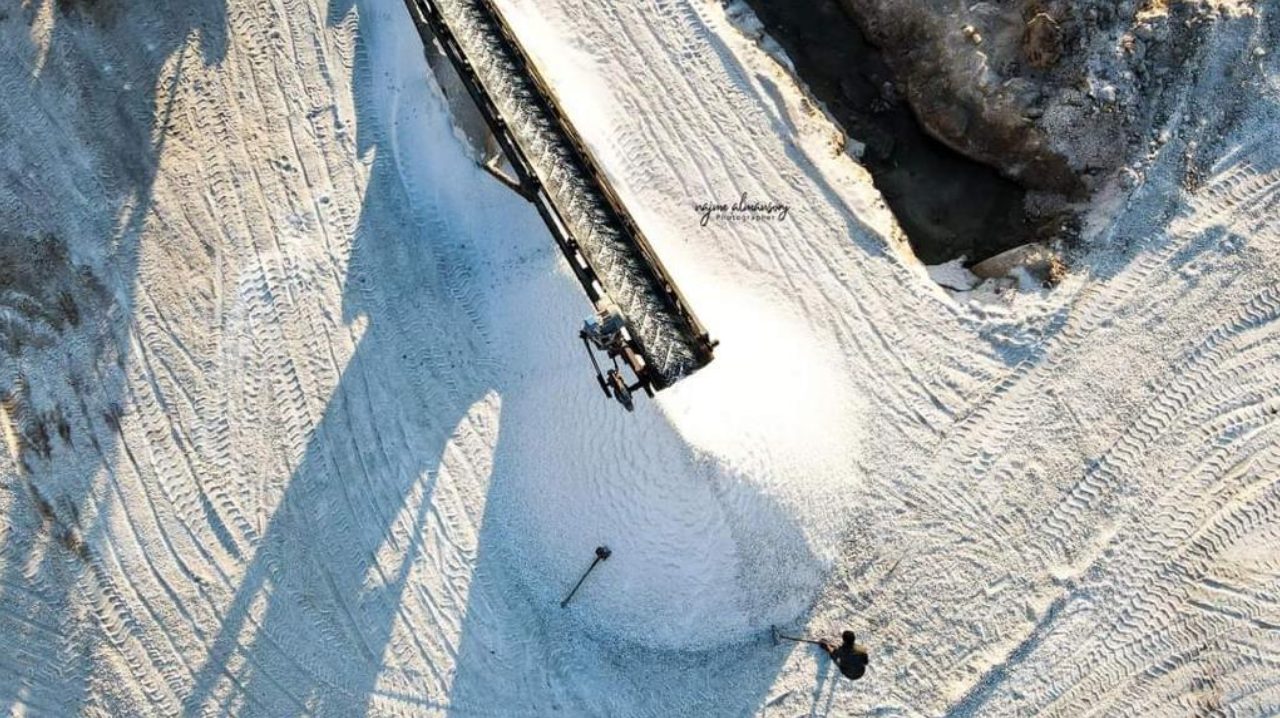
Harvest and washing
98.7–99.4 % NaCl
The remaining bittern is drained, the salt bed is lifted and washed, and the salt is stacked by conveyor to drain before loading.


Baumé values are typical of solar salt practice. Harvesting before the brine passes about 29 °Bé keeps magnesium salts in the bittern rather than in the salt.
The analysis, before the price
Buyers ask for the laboratory report first, so it is here in full: every parameter, the limit buyers usually specify beside it, and the sieve analysis as retained, cumulative and passing fractions.
Contract limits are agreed per lot and confirmed by independent inspection at the load port, so the number on the certificate is the number you receive.
Washed solar salt
Laboratory report, sampled 11 August 2016
| Parameter | Result | Buyer reference |
|---|---|---|
| Sodium chloride (NaCl) | 99.44 % | 98.5–99.0 % minimum on de-icing and refiner sheets |
| Moisture (H₂O) | 1.12 % | 4 % maximum typical; 3 % contract target |
| Water-insoluble matter | 0.10 % | 0.15 % maximum typical |
| Calcium (Ca) | 0.07 % | 0.25 % contract target |
| Magnesium (Mg) | 0.05 % | 0.15 % contract target |
| Sulphate (SO₄) | 0.30 % | Below 0.5 % typical; agreed per lot |
| Calcium sulphate (CaSO₄) | 0.23 % | For information |
| Magnesium sulphate (MgSO₄) | 0.17 % | For information |
| Magnesium chloride (MgCl₂) | 0.06 % | Low; the salt most linked to caking |
| Ferrocyanide (anti-caking) | None | 50–100 mg/kg on request |
| Sieve | Retained % | Cumulative % | Passing % |
|---|---|---|---|
| 12 mm | 0.26 | 0.26 | 99.74 |
| 10 mm | 0.34 | 0.60 | 99.40 |
| 8 mm | 2.86 | 3.46 | 96.54 |
| 6.3 mm | 7.38 | 10.84 | 89.16 |
| 5 mm | 9.31 | 20.15 | 79.85 |
| 4 mm | 16.07 | 36.22 | 63.78 |
| 3.15 mm | 17.80 | 54.02 | 45.98 |
| 2 mm | 28.74 | 82.76 | 17.24 |
| ≤ 2 mm | 17.24 | 100.00 | 0.00 |
79.3 % lies between 2 and 8 mm, 17.2 % is finer than 2 mm and 3.5 % is coarser than 8 mm; 63.8 % passes 4 mm.
| Parameter | Sample 1 | Sample 2 | Sample 3 |
|---|---|---|---|
| Mg (mg/kg) | 80 | 352 | 1,338 |
| Ca (mg/kg) | 1,927 | 2,187 | 963 |
| SO₄ (mg/kg) | 4,903 | 6,663 | 3,133 |
| CaSO₄ (%) | 0.655 | 0.743 | 0.327 |
| MgSO₄ (%) | 0.036 | 0.178 | 0.103 |
| MgCl₂ (%) | 0.003 | 0.000 | 0.442 |
| NaCl (%) | 99.22 | 99.02 | 98.66 |
Three samples, September 2026: calcium, magnesium and sulphate, with sodium chloride by difference. Sample 3 shows 0.44 % magnesium chloride, which is why washing control is written into contracts.
A single washed-salt sample from 2016, transcribed in full. Sulphate moves between lots (0.30–0.67 % across our reports), so every contract carries a per-lot ceiling. Heavy metals and microbiology are part of the ISO 17025 panel now commissioned; report PDFs are sent on request.
How to buy
The terms a procurement team needs before asking for a price. Every quotation states them again in full.
- Load ports
- Tripoli for coasters, Handysize and containers; Zuwara for small coasters. Road delivery to Zarzis, Tunisia, under customs transit.
- Parcel sizes
- Coasters of 3,000–10,000 t. Handysize of 20,000–35,000 t on prior arrangement. Containers from 100 t.
- Packaging
- Bulk in hold, 1,000 kg big bags, or 25 kg and 50 kg bags on pallets.
- Incoterms 2020
- FOB Tripoli or Zuwara as standard. CFR and CIF to your port, FCA for containers, DAP for Tunisia.
- Inspection
- SGS, Bureau Veritas or Intertek sample and draft-survey at the load port. Their results are final.
- Documents
- Certificate of analysis, inspection certificate, certificate of origin, packing list and bill of lading.
- Payment
- Irrevocable letter of credit at sight, or cash against documents for established buyers.
- Season
- Harvest runs June to October. Contract March to July for autumn delivery; spot parcels from stock.
Sailing time from Tripoli
At 11–12 knots, port time excluded.
- Mediterranean1–5 days
Malta, Italy, Greece, France, Spain - United Kingdom and North Sea8–10 days
Glasgow, Ghent, Rotterdam, Hamburg - Scandinavia9–11 days
Aarhus, Gothenburg, Oslo, Stavanger - Baltic11–13 days
Gdańsk, Klaipėda, Riga - North America14–17 days
Halifax, Montréal, Baltimore, Boston - West Africa13–15 days
Lagos, Tema - Red Sea and Gulf6–13 days
Jeddah, Jebel Ali, via Suez
How we contract
What a new origin should make easy for your quality, finance and compliance teams.
Independent inspection
SGS, Bureau Veritas or Intertek sample and draft-survey every cargo at the load port. Their results are final for the contract.
Documents before payment
Certificate of analysis, inspection certificate, certificate of origin and bill of lading, presented under letter of credit at sight or cash against documents.
Screened counterparties
Every buyer, vessel and bank is checked against UN, EU, UK, OFAC and Canadian lists. Salt itself is not subject to sanctions.
Enforceable terms
One contract under English or Ontario law with ICC arbitration, and retained samples kept for 90 days.
Who supplies bulk salt from Libya?
Al Mozan produces solar sea salt at its works on the Ras Ajdir sabkha, western Libya, and exports it in bulk to importers, refiners, distributors and industrial users in Europe, North America, the Mediterranean, West Africa and the Gulf, shipping from Tripoli and Zuwara.
What is HS code 2501?
Harmonized System heading 2501 covers salt (including table salt and denatured salt) and pure sodium chloride, whether or not in aqueous solution or containing anti-caking or free-flowing agents, and sea water. In the EU the subheadings 2501 00 51 (denatured or industrial use), 2501 00 91 (fit for human consumption) and 2501 00 99 (other) carry different duty treatment.
What specifications should industrial salt have?
It depends on the use. De-icing salt: NaCl ≥98–99 % dry, a gradation envelope (commonly 2–8 mm), moisture limits and anti-caking treatment (EN 16811-1, ASTM D632). Refiner feedstock: high NaCl, low insolubles, consistency between lots. Water-softener salt: ≥99 % NaCl and low insolubles (EN 973). Chlor-alkali membrane feed: ≥99.5 % NaCl with tight calcium, magnesium and sulphate limits, which solar salt usually does not meet without further processing.
How is bulk salt shipped internationally?
In bulk carriers: coasters of 3,000–10,000 t for regional trades and Handysize vessels of 20,000–35,000 t for longer routes, loaded by conveyor or grab and discharged by grab or mobile harbour crane. Smaller quantities move in 1,000 kg big bags or 25/50 kg bags in 20-ft containers. Contracts are usually FOB load port or CFR/CIF discharge port under Incoterms 2020, with an independent load-port quality and quantity certificate.
What is the minimum order quantity?
3,000 t for bulk de-icing salt, 5,000 t for refiner feedstock, 200 t for bagged water-treatment salt and 100 t for bagged de-icing salt. Trial containers of big bags are available before a first vessel.
What payment terms do you accept?
Irrevocable letter of credit at sight from a first-class bank, or cash against documents for established counterparties. Payment terms are agreed per contract.
Request a quote
Tell us what you need and where it should go. Export sales replies within one business day with availability, an indicative price on your Incoterm and the laboratory report.
- Reply within one business day, in English or Arabic.
- Laboratory report and specification sent with every quotation.
- Prefer email? sales@almozansalt.com